


Parahyangan Catholic University’s Accounting Study Program won a Competition Grant (Hibah Kompetisi) in the Ministry of Education and Culture’s Merdeka Campus Competition Program in 2021. With regard to the achievement of this competition grant, Parahyangan Catholic University’s Accounting Study Program organized a series of activities, one of which was the debriefing and mentoring of the Accounting Competition Team by inviting accounting alumni and practitioners to deliver the materials for around 35 students of the Accounting Competition Team selected from the classes of 2018 and 2019.
The students gained a variety of knowledge experiences with current topics relevant to the competition and the future of the competition team in the workplace. On Monday, August 9, 2021, an online briefing was held by inviting an alumnus of the Accounting Class of 2012, Mr. Yapi Owenley, SE. He is currently an Assurance Manager – Consumer and Industrial Products and Services (CIPS) at PwC Tokyo, Japan.
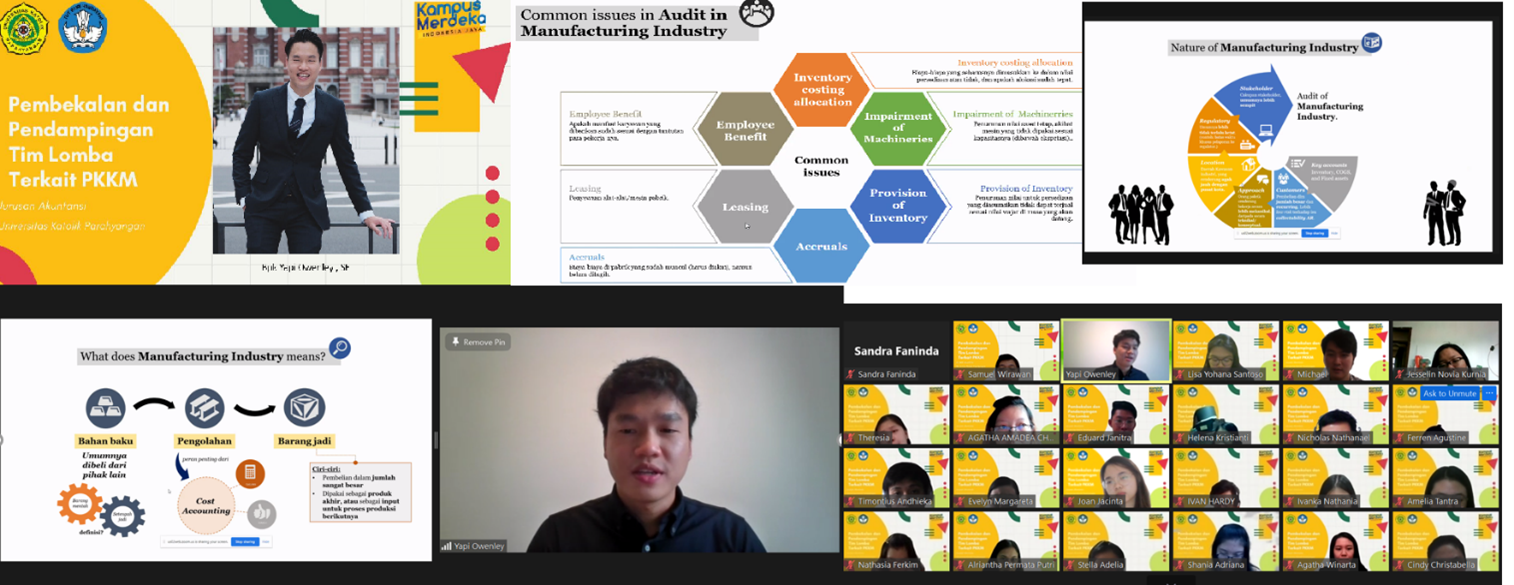
On this occasion, he presented the theme “Audit in Manufacturing Industry” which was very interesting and provided knowledge for the Accounting competition team of the Faculty of Economics, Parahyangan Catholic University. The session opened with a self-introduction and experience by Mr. Yapi. Mr. Yapi then explained about the manufacturing industry. The manufacturing industry itself involves the conversion or processing of raw materials into finished goods. In addition, he also explained the importance of cost accounting to determine which costs can be included and which cannot be included in the value of inventory. Cost accounting also determines how to allocate reasonable costs to the value of inventory, which is seen as how to allocate outgoing costs to each product produced. The two most widely used types of cost allocation are standard cost and actual cost (average).
Mr. Yapi then also explained about the nature of the manufacturing industry. Some common issues in auditing in the manufacturing industry are: inventory costing allocation (costs that should be included in the inventory value or not, and whether the allocation is correct), impairment of machines (acceptance of the value of fixed assets due to machines that are not used according to their capacity), provision of inventory (impairment for inventory that is assumed to be unsalable), accruals, leasing, and employee benefits. The next presentation was about the roles and responsibilities of audit team members: associates, senior associates, managers, directors, and partners. In addition, he also explained about the benefits of auditing in the manufacturing industry and audit differences in Japan, namely: the quality and technical skills of clients, relationships, ‘dressed up’ and other behaviors, persistence of audit staff, commitment, and managing expectations. Finally, Mr. Yapi explained about the auditor’s insight. Key auditors’ behaviors are conceptual understanding and soft skills.